
Electrical cable tensile testing machine
Electrical cable tensile testing machine Measures tensile strength of cables up to 20 metres long. Also carries out elongation tests.
View the project

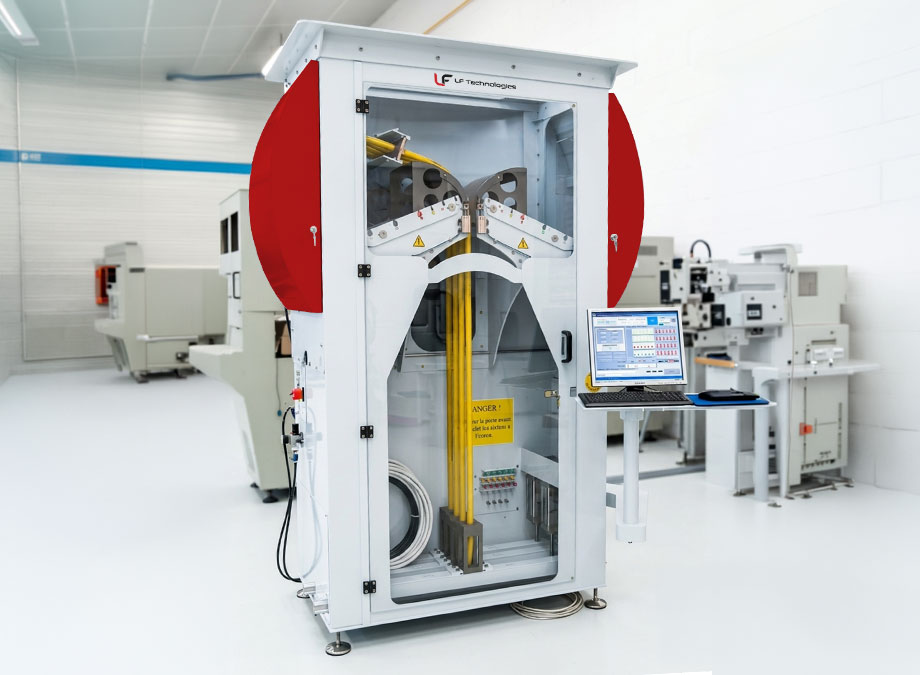
The FLEXCABLE is a testing machine designed to evaluate the fatigue strength of cables subjected to repeated bending cycles under controlled tension. It allows for testing up to four cables simultaneously, with adjustable geometry, bending angle, and applied force according to the characteristics of the specimens.
Controlled by a PC using dedicated software, it monitors test parameters and performs an automatic shutdown in the event of a break, slippage, or loss of electrical continuity.
Products tested
Sector of activity
The FLEXCABLE is a fatigue testing machine designed to evaluate the mechanical strength of cables subjected to repeated bending cycles under controlled tension. It simulates the stresses encountered under actual operating conditions in order to assess the durability of the cables and detect any signs of failure or degradation.
The machine allows you to:
The cable to be tested is secured between two clamping devices and then tensioned using the integrated pneumatic system. Reels suited to the cable’s diameter and the desired bend radius are installed to replicate the operating conditions specified for the test.
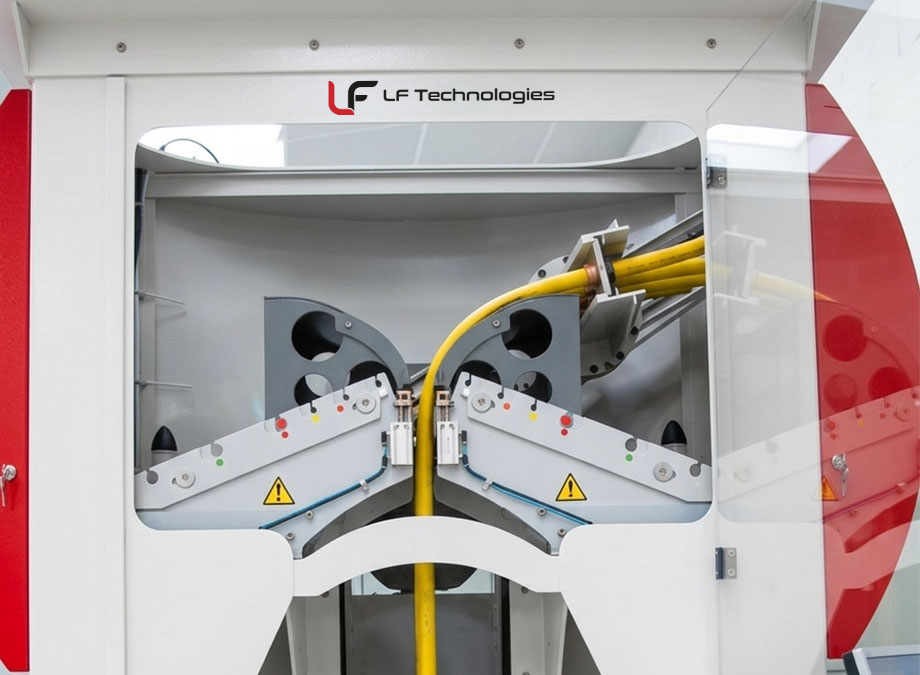
The motorized swing arm then performs an alternating bending motion at a defined angle, while the tension is kept constant throughout the test. The control software automatically manages the test parameters, counts the number of cycles, and continuously monitors the electrical continuity of the conductors.
This automation ensures reliable, reproducible tests conducted under controlled safety conditions.

The machine allows multiple tests to be conducted simultaneously, thereby increasing testing capacity and enabling the comparison of different samples under identical conditions. Depending on the diameter and the applied load, it can accommodate up to four cables at the same time.

The machine checks the electrical continuity of the conductors across 24 channels and automatically stops the cycle in the event of a break, cable slippage, or when the programmed number of cycles is reached.

The lockable transparent door, the side guards, and the automatic stop when the door is opened prevent access to moving parts while the machine is in operation.
Specifications | FLEXCABLE |
Number of test stations | Up to 4 cables simultaneously |
Maximum cable diameter | 100 mm |
Maximum sample length | < 2 m |
Test speed | Up to 20 cycles/min |
Tensile force | Up to 4 000 N per cable* |
Maximum bending angle | 90° |
Electrical continuity check | 24 channels |
Control system | PC with dedicated software developed in LabVIEW |
Dimensions (L × D × H) | 1 210 × 660 × 2 200 mm |
Weight | ≈ 820 kg |
Safety | Lockable door, safety guards, emergency stop and automatic stop upon opening |
* Depending on the test configuration and the number of cables tested simultaneously. |
Discover LF Technologies’ expertise in fatigue test stands through our customer applications.
Electrical cable tensile testing machine Measures tensile strength of cables up to 20 metres long. Also carries out elongation tests.
View the project
Our torsion bench performs tests on test pieces and mechanical parts. It accurately measures torque, rotation angle and torsional stiffness. Its configuration can be easily adapted to accommodate a variety of geometries and dimensions.
View the project
Our torsion test bench allows us to accurately test aeronautical mechanical parts subjected to repeated stress. It accurately measures torque, rotation angle and torsional stiffness, even under demanding conditions.
View the projectExplore our complementary products to get the most out of your fatigue test stand!
Discover innovative solutions to further enrich your experience and optimize your results.


