
Who uses test benches?

What is a test bench?
A test bench, sometimes called a test stand, is a piece of equipment designed to evaluate a product’s performance under controlled conditions. It is used to measure, compare, and analyze precise data prior to market release, during the development phase, or directly in production.
In industry, a test bench isn’t just used to determine whether a product works. Its primary purpose is to understand how it reacts when subjected to conditions similar to those encountered in actual use: pressure, flow rate, temperature, repeated cycles, mechanical stress, leakage, endurance, or even rupture, depending on the type of product being tested.
Let’s take a simple example. A thermostatic mixer can be installed on a hydraulic test bench to verify its temperature stability, flow rate, leak-tightness, or durability. A valve, hose, pump, or industrial valve component can also be tested to verify compliance, safety, or service life.
The test bench can therefore be used at various stages in R&D to validate a design, in the laboratory to qualify a product, in production to inspect batches, or as part of a certification process. Depending on requirements, it can be manual, semi-automatic, or fully automated, with data acquisition, report generation, and traceability of results.
This definition is intentionally broad, as test benches vary greatly depending on the industry, applicable standards, and products being tested. That is why LF Technologies designs custom testing solutions tailored to the specific requirements of each industrial project.
Who uses a test bench in industry ?
Across all industrial sectors, various types of stakeholders may use a test bench. The specific requirements vary depending on whether the activity involves product design, production run inspection, supply verification, or compliance testing.
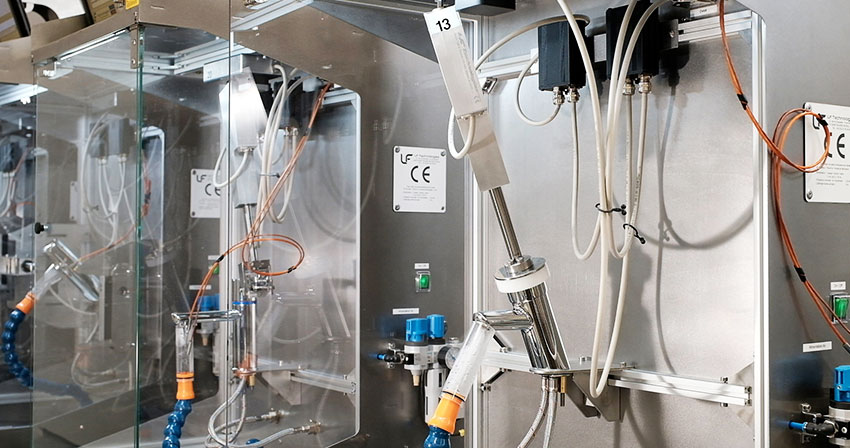
Manufacturers: Validating a product before and during production
Manufacturers are the primary users of test benches. They use them primarily in R&D to validate the design of a new product, compare multiple prototypes, or verify certain technical decisions before moving to production.
For example, the test bench can be used to evaluate pressure resistance, flow rate, leak tightness, temperature resistance, and a component’s performance after multiple cycles of use. These measurements provide technical teams with concrete data to refine a product before it goes into mass production.
Manufacturers also use test benches in production. The test bench can then be used to verify the conformity of a batch, inspect a product at the end of the production line, or quickly detect non-conformities. For quality control and laboratory departments, the results must be reliable, reproducible, and sufficiently documented to be useful over time.
Retailers: managing inventory or demonstrating a product
Retailers can also use a test bench to verify that the products they receive meet specifications before they are stocked, shipped, or installed. This step is useful when products come from multiple suppliers or when they must meet specific performance, safety, or durability requirements.
The test bench can also be used for sales demonstrations. In this case, it allows you to demonstrate a product’s operation, performance, or durability under controlled conditions. This is more effective than a technical data sheet, especially for products subjected to pressure, flow rates, temperature, or repeated cycles.
Certification bodies: verifying compliance with standards
Certification bodies use test benches to verify that a product complies with a standard, a specification, or a quality mark. The tests must therefore be accurate, reproducible, and properly documented.
In this context, the test bench serves both to measure and to produce reliable evidence. The results must be able to be read, compared, and archived without ambiguity. Depending on the products being tested, these processes may involve organizations such as the CSTB, AFNOR, or other bodies specializing in testing, qualification, or certification.
Whether used by a manufacturer, a distributor, or a certification body, the test bench therefore serves the same fundamental purpose: to obtain reliable measurements in order to make a technical decision, validate a product, or ensure its safe release to the market.
Depending on the situation, a test bench may be used as early as the design phase, prior to mass production, during production, or as part of a certification process. It is used to compare a prototype, inspect a production run, verify compliance, or document test results.
What types of tests can be performed on a test bench?
The tests performed depend primarily on the product being tested and the expected results. On a hydraulic test bench, for example, it is possible to measure a component’s pressure, flow rate, temperature, leak tightness, or strength after several cycles of use.
These tests allow for the evaluation of the performance of a faucet, mixer, valve, hose, pump, or other equipment under real-world conditions. Depending on the requirements, the test bench can also be used to conduct endurance tests, leak tests, hydraulic tests, or burst tests.
In other cases, the testing machine may be designed for mechanical testing : tensile, compression, torsion, bending, fatigue, impact, or peel testing. The goal remains the same: to obtain reliable measurements to understand the product’s behavior, detect any weaknesses, or confirm its compliance.
Some tests require very specific equipment. This is the case for cyclic pressure tests, water hammer tests, and burst pressure tests.
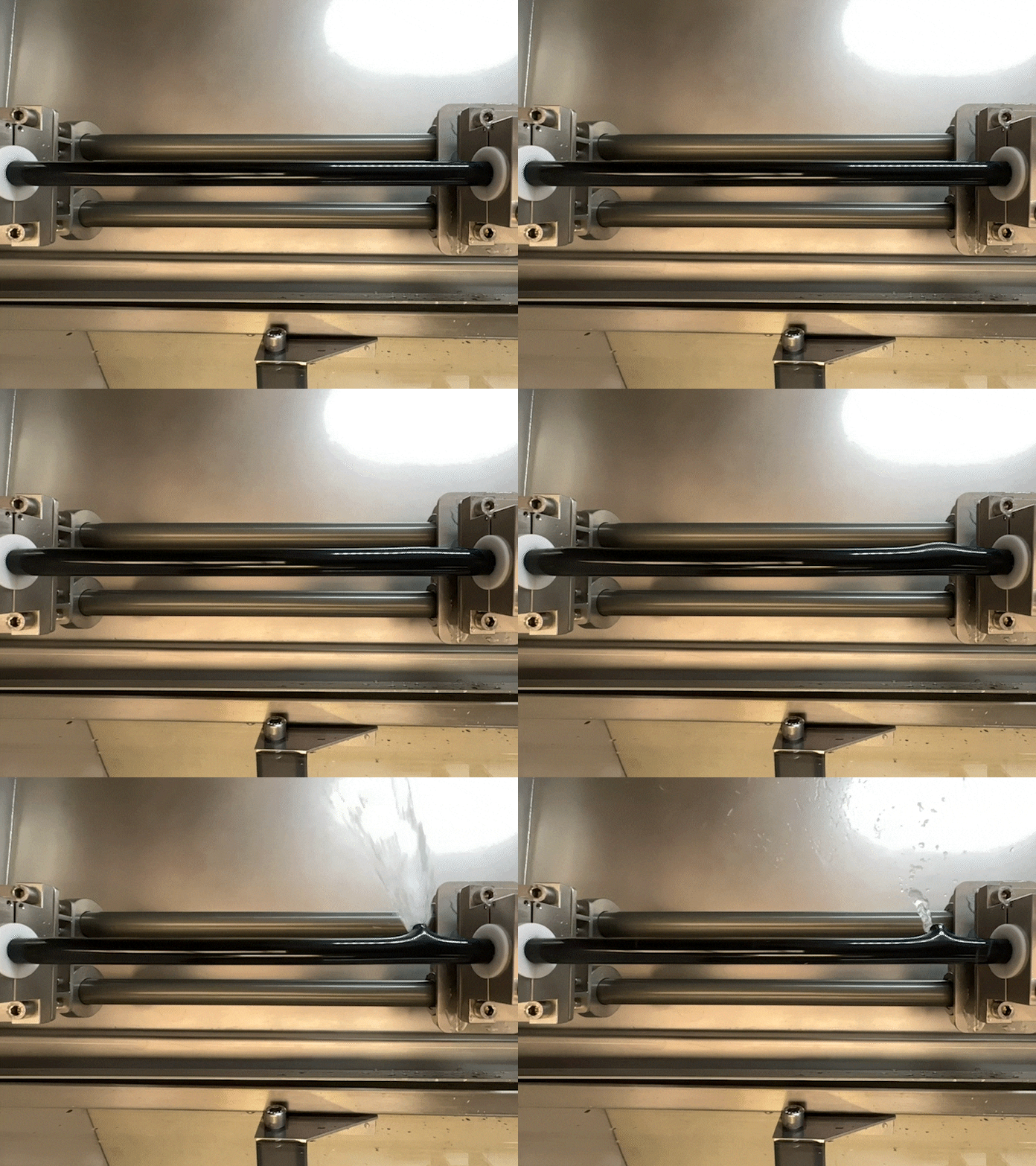
How do you choose a test bench that meets your needs ?
The choice of a test bench depends primarily on the product being tested, its intended use, and the defects one is seeking to detect. A faucet, a valve, a hose, a pump, or a mechanical part do not require the same test conditions or the same measurements.
The applicable standards, the expected level of accuracy, the frequency of testing, the test environment, and the desired level of automation must also be taken into account. A test bench used occasionally in a laboratory will not be designed in the same way as a test bench installed on the production line to inspect production runs.
When requirements go beyond standard specifications, the test bench can be designed as a custom-built special-purpose machine, tailored to the product, the test environment, and the expected results.
At LF Technologies, every test bench project begins with this needs analysis: understanding the product, the tests to be performed, the standards to be met, and the conditions under which the equipment will be used.
Do you have a project ? Contact us to bring your testing and validation projects to fruition.
Thibault MARCHAND
LF Technologies, your partner in pushing the boundaries of your testing.
Discover other articles and tips

What methods are used to test pipes in the building industry?

What are the main tests performed on sanitary fittings hoses?

What are the main types of water heaters ?
